Did the world work as intended? Did we come to earth to celebrate our uniqueness, our individualism or our shared paths together? Did we perhaps intend to make our world the shape it is today or was it an accident of history unfolding past and beyond human comprehension? Or did we perhaps lose our way and turn our attention to what we today call “leaders”, “businessmen” and “politicians”?
These questions are not questions everyday people spend their time answering. Instead, people are quietly passing the time with busywork. Today, we are born into a society that creates intense pressure from birth until death, in which a person is expected to live up to a certain standard, raised year after year as technology advances. People do not pause to reflect on this; instead the usual response is to wait and expect someone else will rise and explain the situation for them. They turn to politicians, leaders and businessmen, people who are at the forefront of the media speaking their words and expecting that their answer is the only answer.
In today’s world, people have become complacent, turning attention from human connection, often distracting from the truth that is buried within each and every one of us. When we “Forge a New Path”, we invariably look at what went wrong and how we can improve our lives moving forward. When we look at our society, we see that it changes not through policy decisions but through the people who act on them. A policy, law or rule is just a piece of paper with something written on it. The people who enforce them are doing the real work. It is much like saying, “give a man a gun and he has the weapon. Give a psychopath a gun and he can rule the world.”
Psychopaths have lots of guns in their arsenal. We gave them that power. We built the guns and we gave them to men and women of power. Had we kept the weapons for ourselves, the world may perhaps be slightly different. But we did not.
I should note to the reader at this point that this series is not about sending a political message or reiterating what so many others have spent decades researching, but rather to consolidate these various messages into a coherent jigsaw puzzle that can be understood. Most of the world we live in is based on a large misunderstanding. We have conflicts that are the result of misunderstandings, politics that shape our world that do not align with the interests of humanity, and the systems that exist are perhaps the most misunderstood of all.
To understand the systems we have helped build for ourselves, we need to understand why we built them. Is it simply that we needed a “job” and those “jobs” create the prison through which we inevitably live? Is it that people put their needs above others, that regardless of the consequence resulting from their “jobs” – their “busy work lives” – that the world is the way it is? Do we believe even though we do what we must to keep ourselves alive that our efforts will pay us dividends in ways we did not previously expect? Or perhaps are we blind to the inevitable prison we have built around our lives and continue to build it anyway, even if we are in full knowledge of it?
These are all questions that have complex and deep answers, but there is a better question yet to surface from this: Why do we build anything at all?
In all my years of searching for this answer, I have personally come to the conclusion that we build out of passion. Whether that passion is an act true to our very nature or whether it defies all reason is another question entirely, but there is one thing we should at least consider before we proceed and that is to first understand human nature.
As humans, we turn to the thing that makes us most comfortable – the path of least resistance. In doing so, we create a kind of social and subconscious security that ensures we do not do something that makes us uncomfortable. When we are put in positions that make us uncomfortable, we argue, we get angry, upset and often violent. Because we are comfortable with being comfortable, we have created within ourselves a situation in which any form of discomfort is immediately brushed off and rejected, even if the truth lies buried underneath.
To better understand ourselves and to thwart any temptation to resort to needless rhetoric or, for that matter, violence, it may be worth looking at how we can learn to become “comfortable with the uncomfortable”. It is by forging this new path we can examine within ourselves a new future right here, right now.
But first, I would like to turn our attention to the various aspects of all this to ensure this cohesive jigsaw puzzle can make sense.
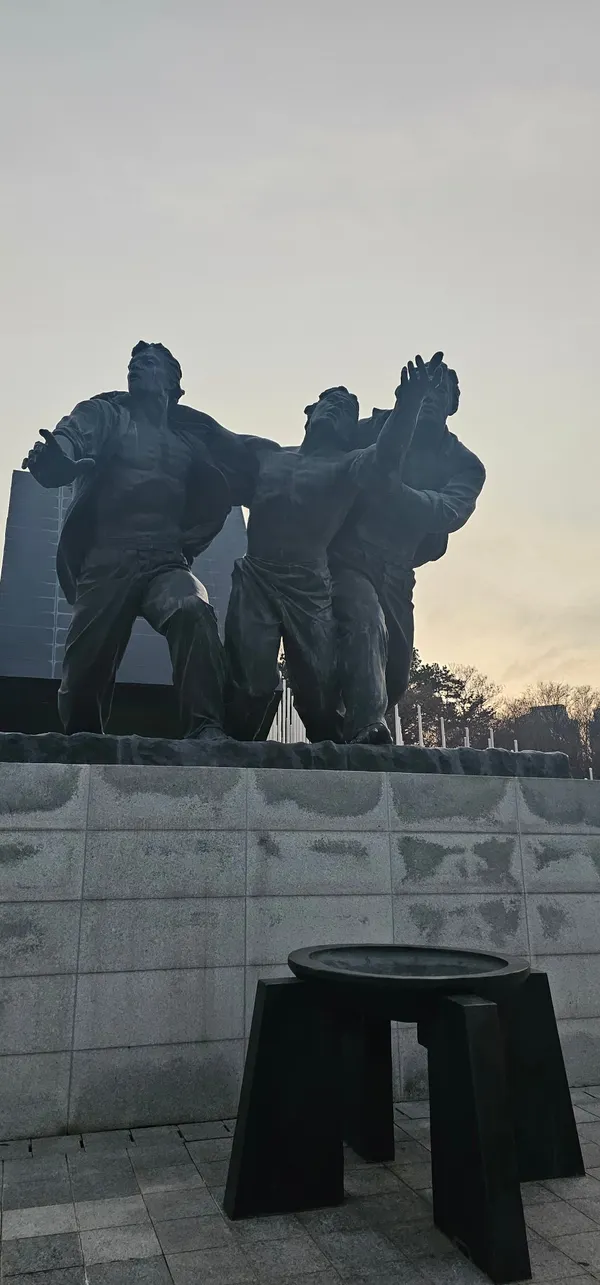
This series is divided into four parts. The first explores our history. My focus has been on the Korean Peninsula, because this seemingly endless battlefield, both politically and physically, demonstrates crucially just how bad things can get if we don’t act soon.
The second part explores looking inward and examining our own individual self. It will show us what we do as individuals, explore the passions that drive us forward, introducing the well-known Bashar and his channeler, Daryl Anka, followed by others in the spiritual space to look at these passions and to give a more coherent understanding of what passion is, how we can act on it, where we gain clarity, sharpen our focus and improve it. It will equally explore technology and how it can distract us from our passion and our goals. We will dig deep into the human brain and understand our hormones and reward centres, so we can tune out those things that no longer serve us and bring to the fore new energy and new habits that improve our lives and, ultimately, raise our vibration.
The third part shows us what our history has illustrated and what exists now that can be reshaped. We will explore synchronicity as a currency; spirituality and what it truly represents, the issues with new age rhetoric and the minefield of religious texts that ultimately distract us from ourselves; business and what trading is, and how it can be re-explored and what future there is to improve this from a spiritual perspective.
The final part explores artificial intelligence. We look at how it can enhance creativity, explore automating laborious processes and improving the techniques of our craft. We will also look at the downsides and the pitfalls of the technology, when to use and not to use it, how to overcome dependency on it, and the moral implications. One thing to note on that last point is that while there is ongoing political activism at the time of writing against the development of new data centres, I wish to emphasise that I am cautiously optimistic about AI. It is a technology that, when used responsibly to enhance or improve your work, can significantly improve our future. I would also emphasise that although some people may blindly argue against using it without understanding why people use it, the effort to prohibit AI usage may result in a cyclic inner doubt that can be worse than the alternative, which is to give people the freedom to use AI without restriction and without consequence for using it. It is not up to others to judge our use of a controversial technology or tool.
Forging a New Path is part of an online web series that also includes audio podcasts. This series takes us through all the above points, and closing out on where we can go from there. My personal interests and passions lie in writing and programming, both of which we can learn.
If you wish to explore this journey with me, consider subscribing to gain access to the full series and podcasts. In the meantime, explore the various articles I have written on this website. My exploration of Korea and the many things representing it I would release free of charge, irrespective of where this series takes us.
You can start reading the series here, and various definitions and spiritual understanding of our world can be found in the Foreword.